-
Recent Posts
Recent Comments
Rodney on Disney’s ‘The Layo… Rodney on Disney’s ‘The Layo… Rodney on Disney’s ‘The Layo… Rodney on Disney’s ‘The Layo… Rodney on Disney’s ‘The Layo… Archives
- February 2026
- October 2025
- April 2025
- March 2025
- October 2024
- May 2024
- August 2023
- October 2021
- March 2021
- February 2021
- October 2020
- August 2020
- May 2020
- March 2020
- October 2019
- September 2019
- August 2018
- July 2018
- May 2018
- March 2018
- February 2018
- January 2018
- December 2017
- November 2017
- October 2017
- September 2017
- August 2017
- July 2017
- June 2017
- May 2017
- April 2017
- March 2017
- February 2017
- October 2016
- September 2016
- August 2016
- July 2016
- June 2016
- May 2016
- April 2016
- March 2016
- December 2015
- November 2015
- October 2015
- September 2015
- August 2015
- July 2015
- May 2015
- April 2015
- March 2015
- January 2015
- September 2014
- August 2014
- June 2014
- May 2014
- April 2014
- January 2014
- May 2013
- December 2012
- October 2012
- April 2012
- January 2012
- December 2011
- November 2011
- September 2011
Categories
Meta
Don Bluth’s Weekly Seminar
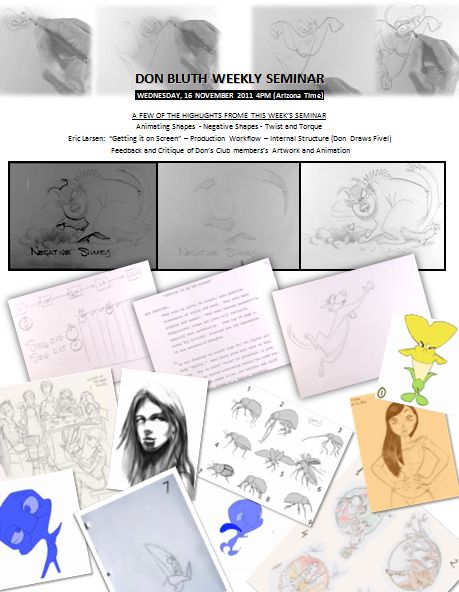
I grabbed a bunch of screen shots from this week’s seminar to illustrate some of what is covered during these hour long seminars.
These are seminars where you get to personally interact with the legendary Don Bluth. Think about that for a moment… THE DON BLUTH.
Get your act together and sign up!
Wednesday’s at 4PM (Arizona time)… 8AM in Japan.
Posted in Uncategorized
2 Comments
Wacom Inkling – Drawing on paper and the computer simultaneously (What’s the big deal?)
After posting on the subject in both the Don Bluth and Animation:Master forums I’ve been involved in ongoing discussions on the usefulness of this technology in both places. To my way of thinking this allows me to better understand views from the perspective of those who empower traditional animators (Bluth) and computer animators (Martin).
Whether this technlogy seems to be important appears to primarily boil down to whether the artists wishes to use traditional media (in this case paper) or a digital (virtual) representative of the same. To my way of thinking both approaches are needed and must be investigated if we are to further bridge the gap between artist and technology and to explore the future of animation.
Technologies such as Wacom Cintiq bypass the ‘original’ physical media to capture a representation directly in the computer. Having the original work may be important (to the creator) for a number of reasons but for now I’ll focus on primarily one aspect:
A physical original is generally a unique creation that would take a skilled creator to reproduced or duplicate. Copies of the original (re-presentations) can generally be produced easily but tend to be identifiable as counterfeit upon close examination of and comparison to the original. An original is unique.
A byproduct of this uniqueness is intrinsic value. Like it or not scarcity often determines value and in a world where the law of supply and demand remains in effect having access to that original is a point of distinction (if not contention). In the digital realm the original is exactly reproduced to the point where in almost all cases there in no verifiable original. The only way to secure value is to limit access to the original and in a digital world this runs counterproductive to the usefulness and effectiveness of open systems. Sharing resources is one of the most valuable elements of product-ion and re-presentation.
What technlogolies such as the Wacom Inkling represent is a narrowing of the gap between the extremes and a means to gain scarcity with ubiquity; something found only in one place yet found everywhere (in a user defined enhanced form) simultaneously.
http://inkling.wacom.eu/pages/Inkling-en-inkling.html
Discussions:
Don Bluth forum discussion
(Requires forum login)
Posted in Uncategorized
Leave a comment
100 years ago and today – a century of animation chalk talk performers
The more things change the more they remain the same. – attributed to Jean-Baptiste Alphonse Karr who coincidentally was born just over 200 years ago in 1808 and died just as Winsor McCay was arriving on the scene.
100 years ago (1911) almost to the day, the cartoonist Winsor McCay began presenting animated films on stage starting an adaption of his well known comic strip Little Nemo in Slumberland and the highly educational How a Mosquito Operates. In 1912 plans were announced to bring a dinosaur to animated life and on February 8, 1914 the film arrived on the silver screen. This animated dinosaur McCay who affectionately called Gertie not only moved around the screen and entertained audiences… it interacted with him… at one point even taking a bite out of the apple from McCay’s hand, a skillfully performed illusion McCay borrowed from the trade of magicians.
After 100 years one might think such performances might be pass’e… and to a degree I’d agree with this assessment. Where I might differ is that I find these chalk talk performances to be just as entertaining (and valuable).
The Technomagician and Cyber Illusionist Marco Tempest is following this grand tradition and plusses it up with some of the knowledge and technology of today.
Marco Tempest Cyber Illusion Keynote presentation
(This is a bit long but well worth your time and attention)
Posted in Uncategorized
Leave a comment
Leonardo DaVinci the Animator? (Everything new is old again)
Over the years I’ve seen a lot of references to various precursors to animation:
Suggestions the Pharaohs had reliefs painted on columns so that visitors could be amazed at the ‘living beings’ that danced as they whisked through the causeways on chariots at high speed.
Belief the images on cave walls represent animals in motion (perhaps used to teach young warriors how to better strike at their prey during the chase).
A desire that the vases with variations in their imagery could be spun to create ‘motion pictures’.
As I’ve read these reports I’ve mostly viewed them with a great deal of skepticism but cannot help but feel we are falling as far short of the truth as we are exaggerating what we think we see there.
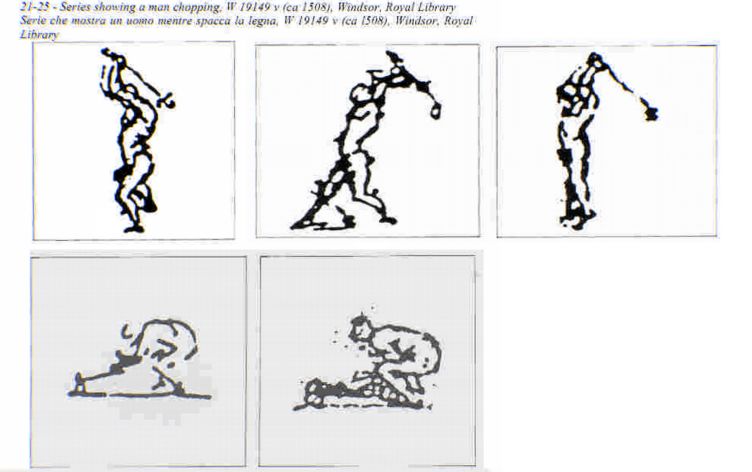
One example in this same area that I haven’t presented elsewhere as an example of a precursor to animation is the following sequential images attributed to Leondardo DaVinci:
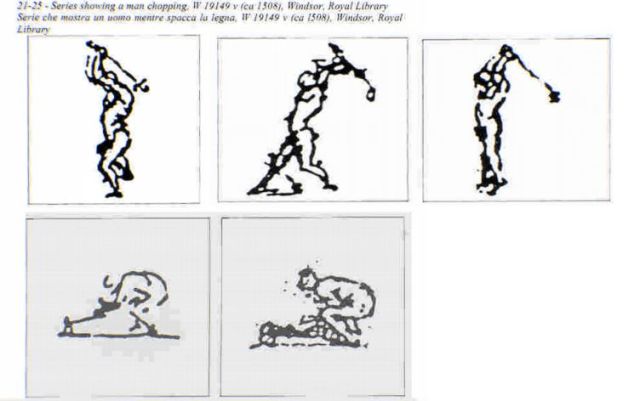
What principles of animation and composition can we see here:
- Anticipation
- Pose to Pose
- Squash and Stretch
- Straights and Curves (and Straights against Curves)
- Line of Action
- Opposing Arcs
- Silhouette
- Clarity
See anything that I’ve missed?
Is there any question that Leonardo understood a great deal about how things (both mechanical and organic) were motivated and manipulated? What of his studies in anatomy? What of his imaginary (flying) machines?
If the field of animation was already this refined in 1508 perhaps we aren’t even close to scratching the surface of animation history.
Posted in History, Technology
Leave a comment
What is the ‘New’ Art of Animation?
Animation is an exciting field of endeavor with a long and varied history. It is a growing field that cross references aspects in all other fields in some way or another. This blog is a look at the state of the art of animation and related subjects from my (mostly optimistic) perspective.
Some general conclusions up front:
- Everyone can enjoy animation. (Animation created with a strong foundation in the principles is going to communicate better)
- Everyone can be creative. (The more you write, draw and explore the better you’ll be at it)
- Computer Graphics (CG Animation) is here to stay. (Use it to best advantage)
- The art of hand drawn animation isn’t going away. (Prove the theory: Draw some animation on a piece of paper today!)
I hope you’ll join me in the exploration.
Posted in Uncategorized
Leave a comment