Exhibit A: Why Stan was the Man

This seems fitting for my first posting with a focus on comics.  It’s such a treasure trove of material that I have five titles that this could have fallen under.

It’s hard to talk about comics without mentioning a few names and two of them are Stan Lee and Jack Kirby.  We’ll talk more about the King of Comics later (there is a lot to talk about when it comes to Jack Kirby!) and for now demonstrate some of the genius of Stan.

Here we see a short two pages of notes that discusses a cover of an issue of Avengers Giant Size (which is much like an Annual).   Because the image may be a bit hard to read here’s a copy of that text:

From the Desk of … Stan Lee

(To) Len Wein:

Len:

There are 2 “dead spaces” on this cover.  In one of them, I added balloon “AVENGERS ASSEMBLE!”

In the other, I indicated a splash area for a blurb.  Try to write something to the effect of SPECIAL ACTION ISSUE!  COSTUMED SUPER-STARS IN PROFUSION, BATTLING TO THE DEATH!

Always look for, and try to recognize, the so-called “dead areas”.   By livening them up, either with additional artwork, or zippy copy, you can often add a helluva lot more excitement to a cover.  It’s one of the things that always gave and will give us an edge over the competition.

Discuss this with Marv and explain to all your assistant editors too.  It’s really a most important point.

(See additional attached note – Stan)

Another important point which goes for ALL covers, as well as this one—

Note Giant-man’s face, and Hawkeye’s, and Dr. Strange’s…. They don’t look EXCITED enough—or VIOLENT enuff, or SCARED enough, or ANGRY enuff, or whatever.

ALWAYS make sure the characters have some sort of extreme, exciting expression on covers—and of course, inside as well.  We can never convince reader story story is exciting if the characters themselves don’t look excited!

I’ve told this to all our staff a million times over the years, but it can’t be mentioned too often.  It’s VITALLY important.  Often a story that seems dull could seem twice as exciting with more excitement being registered by the characters.  Always look for, and try to remedy, such situations.

-Stan

The first thing to note is that without specifically saying it, Stan has made a distinction between negative space and dead space.  His focus is fully on dead space here.  What is dead space?   Well, first and foremost Stan relates that it is something he has stated ‘millions of times’ and stresses as a “most important point.”  Dead spaces are those areas on the cover and on the inside pages of comic books that Stan directs Len to “Always look for”,  to “try to recognize”, and to “liven up” by adding artwork and text.  Stan suggests that by livening up these dead spaces in such a way they will add “a helluva lot more excitement” which was something that historically given them a competitive edge and would continue to do so if they continued to pay proper attention to it.

But Stan isn’t just filling space for the sake of filling space.  He’s enlivening those spaces where which were dead.

Moving on to his additional notes Stan then further directs Len to consider something of vital importance; that each character’s facial expressions must be drawn as an extreme and not just as a well drawn face.  He then even emphasizes how those faces should look; excited, violent, scared, angry… whatever!  Not a tame boring word in there but every one full of action; the very essence of the superhero.

These extreme emotions are caricatured by exaggerating the emotions projected from the characters.  But why should we target these extremes?  Stan answers that with expert insight by suggesting that readers cannot be convinced to be excited if the  characters are not excited themselves.  So obvious it shouldn’t have to be said right?  Sure, but if that is the case why did Stan need to say it and say it repeatedly?  Because there was no evidence of those emotions being expressed in the characters the artist (however talented) had drawn on the page.

He finishes his note with an admonishment:  “Always look for, and try to remedy, such situations.”

Images/Scans courtesy of:  http://themarvelageofcomics.tumblr.com
Posted in Uncategorized | Leave a comment

More Tap!

The last post was about tapping and this is an extension of the theme.  I want to call your mind to it via two recommendations; one another blog and one a video lecture course.

Last month, Ferdinand Englander posted on animating to beats in a post titled:  ANIMATION SECRET: ANIMATING TO MUSIC.

Check it out, it’s highly recommended.

(Here’s a direct link if the image above doesn’t work:  http://www.animatorisland.com/?p=174)

For folks like me that are a bit short on musical talent I highly recommend the video lecture over at Yale University.  It’s serious enough to work if’n it sinks in.  😉

Here’s a brief description of the course:

Professor Wright begins this lecture with a brief introduction to musical acoustics, discussing the way multiple partials combine to make up every tone. He reviews fundamental rhythmic terms, such as “beat,” “tempo,” and “meter,” and then demonstrates in more depth some of the more complex concepts, such as “syncopation” and the “triplet.” Professor Wright then moves on to discuss the basics of musical texture, giving detailed examples of three primary types: monophonic, homophonic, and polyphonic. The class is then taught the basics of rhythmic dictation — skill that entails notating the rhythm of a piece after listening to it. Each of these disparate threads is brought together in the conclusion of the lecture, in which Mozart’s Requiem is shown to weave different rhythms, textures, and pitches together to depict the text effectively.

The Link:  http://videolectures.net/yalemusi112f08_listening_music/

 All in all 10 lectures of about 1 hour each (10 hours total) of very useful ‘musical listening’ training.  I’m watching them now in hope that something might sink in! 🙂

One useful bit I picked up on was how the emphasis is placed on the down beat.  This is also where musicians often facilitate rhythmic change.

The last post was of a silent animation but hopefully they won’t always be!

Posted in Uncategorized | Leave a comment

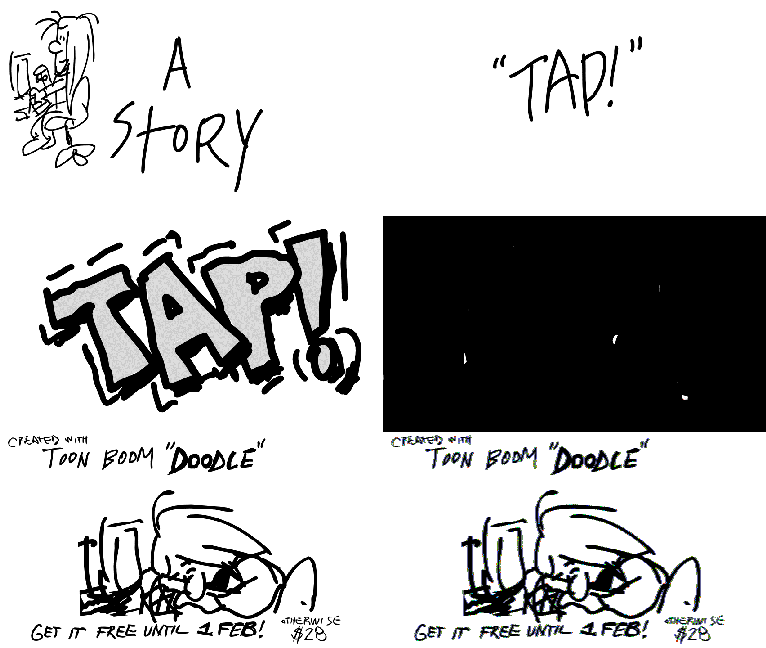
‘Tap!’ a (very) short film created with Toon Boom Doodle

Today is 18 Jan (in Japan)… do your kids have Toom Boom Doodle yet?

Only 13 days to go before you gonna haffa pay .

Today I reinstalled TBDoodle (because for some strange reason it disappeared off my computer!)  Recommendation:  Save a copy of the program installer *and* your activation code!  As you can see below the re-installation worked fine.  It would not have been great to get to 2 February and realize I’d lost my activation code or went to download the program again only to find it was no longer available.

So, anyway… I started doodling and the lines all kind of bunched up together to form this thing…

I also drew a couple of Owls and a kid playin’ superhero as an attempt to create some storyboard-type stuff… and make sure I understood Doodle’s Library.

Kidstuff.  Gotta love it.

So simple that drawing is fun again.

(Note: The program doesn’t create gif animation. If you are curious ask me about that process and I’ll be glad to talk about it here.)

Posted in Uncategorized | Leave a comment

Toon Boom Doodle (Free until 1 February)

I’ve been sitting on this for a few days while thinking how best to suggest it to everyone. Most who are into animation already have something capable of animating similarly.

In conjunction with CES 2012 Toon Boom is releasing their Doodle software.
See this announcement.

So here is the deal… I challenge and encourage everyone to find as many kids as possible and help them download and install Toon Boom’s Doodle. With it they can learn how to animate. I believe many will learn how to animate better, faster with more effectively use timing because of this software. I sure wish I’d had access to TBDoodle and the knowledge of animation available today when I was going up.

Download Toon Boom Doodle for free (until 1 February)

…and this isn’t just for kids. You can use Doodle to quickly sketch out and time your animation.
Get this software onto every kids computer so they too can learn the art of animation.

Personally, I think Toon Boom will offer this again but kids everywhere should have to wait. They need to start animating now!

Posted in Uncategorized | 1 Comment

‘Steamboat Willie’: The Sound of Transformation

Mark Mayerson posted an excellent review about the recently released book ‘The World History of Animation’ by Stephen Cavalier and lists a series of errors he discovered in the book. Importantly, the focus of the review is on the errors he found. As I read through, I was nodding my head in agreement until the following one…

Mark states:

On page 97, Cavalier says that Steamboat Willie was half finished before Disney made the decision to make it a sound cartoon. This is wrong. The synchronization that is Steamboat Willie’s great advance was due to planning the musical beats in advance of animation.

While I don’t know where Cavalier gets his idea for the movie being ‘half finished’ and then retooling as a sound cartoon, I am inclined to believe he correct for a number of reason. Space only permits me at this time to pursue one except to say that the argument suggesting planning musical beats in advance of animation began with ‘Steamboat Willie’ doesn’t hold up. Even before this film music was considered a very important part of animation. I’m no expert there so perhaps we can explore that aspect further after I’ve studied it.

The most compelling evidence to suggest Cavalier is at least mostly correct is the storyboard for ‘Steamboat Willie’. Note how right after the “-Main Title” there are very specific instructions for a live orchestra. The way it is written cannot be instructions for and orchestra enlisted to record a sound movie because of its suggestion to create various arrangements coupled with its emphasis to hit certain cues. I must say it certainly reads as written for a live performing orchestra. If the film was not intented for live orchestra accompaniment then this document’s origin should be considered suspect.

My thought: Since at this time not all theaters were likely equipped to play sound in sync with moving pictures, Disney probably targeted theaters both with and without the technology. Given that cartoons were often held onto and reworked until they fit into proper scheduling, I think it reasonable to say Walt Disney originally did not plan the movie to be gifted with sound but saw the opportunity and took advantage of it. (I seem to recall the xsheets/draft indicate several strategic additions to allow Mickey some breathing space…. I’m willing to guess it was for sound).

At a minimum, the storyboard suggests the author’s assertion of the film being half way done before shifting to sound may require further thought. Knowing Cavalier’s reference would certainly shed some more light on the subject.

Respectfully submitted for your consideration.

None of this detracts in the least from Mark’s review so everyone should check it out!
Mark’s Blog: http://mayersononanimation.blogspot.com/2012/01/review-world-history-of-animation.html

Posted in Uncategorized | 4 Comments

Draw at least 27 drawings every day… (Part 1)

Wanna be an animator?

By my calculations…
In order to be the animator that you want to be you’ll have to draw at least 27 drawings a day.

Wanna be a comic book artist?
In comic books this would equate to (a minimum) of one finished page (of pencils) per day.
I haven’t factored it but I’m going to guess a comic strip artist should average three (rough) strips every day while completing at least one (a fourth from a previous rough) every day.

If you take off on weekends (which you should) you may need to put in a little more time during the weekdays. Rough out those extra drawings to get the ideas down on paper.


This image is a little hard to read but read what is inside and around the boxed area.

So, what does this really mean?

Draw more than one drawing a day!

Here’s a close up to help it sink further into the brain:

Posted in Uncategorized | 1 Comment

Character First! (even when animating Forces)

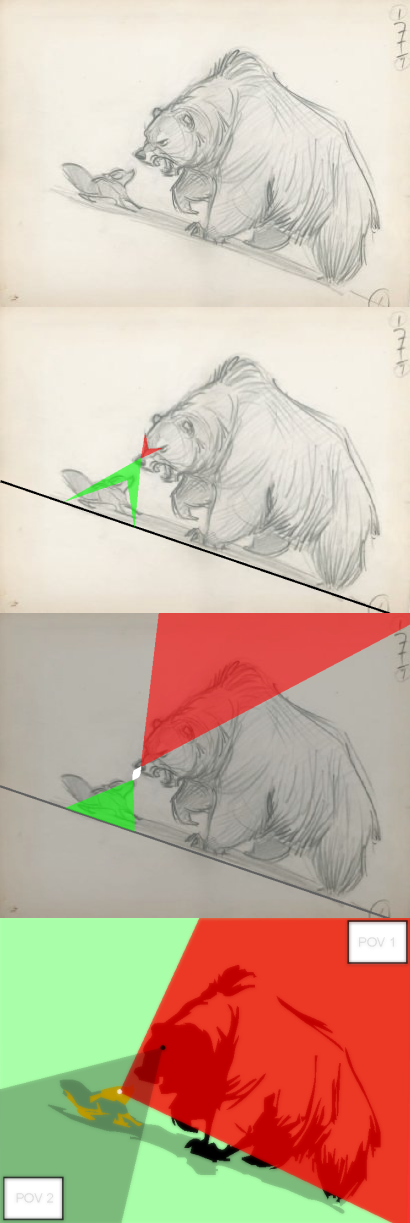
I enjoyed looking at this drawing from Disney’s ‘The Fox and the Hound’ and thought I’d explore it a little. It is likely drawn by Glen Keane (I have no reason to think otherwise).

There is a danger of reading too much into an artist’s intent so this is not so much of an exercise into what Keane was thinking as he drew as it is one of getting into the idea of how forces and forms, personal spaces, points of view and such flow through ever scene and are there waiting to be discovered by us.

In the final image you can see two boxes in the lower left and upper right corners. These are spaces that reflect what the character is actually seeing. Although I haven’t made an attempt to draw them, it’s a pretty safe bet that when looking at the scene we’ll see some of these POV shots briefly in order to keep us fully immersed, caught up in the emotions, and empathetic to the characters.

When personal space diminishes to where two people are face to face or nose to nose (or at least reasonably close) the two are either in love or in conflict. Either way they are fully engaged in the moment.

There are many words come to mind while viewing this image but the one I’m feeling the most is ‘tension’. These two are not in love. So, we are storing up energy as we anticipate the release of the intentions of two characters motivated by too little personal space. The conflict is dictating… forcing… something to happen.

I’d have to compare this drawing to what appears in the film to see what made it all the through but I’m also attracted to the sloping ground plane. Note how gravity (the gravity of the shot and the situation) is not working in favor of the fox. It’s almost as if he’s about to slide under the mass of the bear. It would certainly take more effort for him to move up and out of screen left and he can’t escape through the ground. The only other option is to meet this monstrous bear head on and fight!

At any rate… that Glen Keane sure does some nice drawing.
If anyone knows where to find the other six drawings associated with this key drawing, I’d love to see all of them in sequence and in context.

Source of image: Rossini Auctions (http://www.rossini.fr/html/fiche.jsp?id=1103120)

Posted in Uncategorized | Leave a comment

UM 1 “Mickey’s Nightmare”

Hans Perk has posted the animation draft to Disney’s 1932 film ‘Mickey’s Nightmare’. If you are into animation and haven’t taken a little time to look through Han’s site you are missing out on some great information. ( http://afilmla.blogspot.com )

As a means of studying this classic film, I converted the draft into a spreadsheet and have it shared online for those interested (Note: You can save Google Docs out to pdf files for easy reference):  The Draft converted into a Google Docs spreadsheet

Looking through some of the information we see:

9 Primary Animators worked on the film (unknown number of assistants)
10004 frames were drawn/created for the film. That is 625-4 feet of animation at 16 frames per second for a running time of 06:25:04 (6 minutes, 25 seconds and 4 frames). Add approx. 28 seconds for the title cards/intro and 10 seconds for the end of the film and we have about 7 minutes 30 seconds for the whole film.

The draft is dated 20 Apr 1932 and the film was released 13 Aug 1932 for a 115 day turnaround time if the math is to be believed. At a rough guess that works out to about 3 months of production time for the animators.

Let’s see how the math keeps holding up (some checking has already allowed me to correct myself in a few particulars (for instance, I originally thought there were only eight animators assigned to this draft):

(Disclaimer: Hans likes to remind us that just because a draft says a particular animator is listed in the draft does not mean they actually were the one that animated the scene)

Animators
1 Ben (Total) 1350 Frames 84.4 Seconds
2 Cannon (Total) 452 Frames 28.3 Seconds
3 Dave (Total) 2536 Frames 158.5 Seconds
4 Fergy (Total) 2366 Frames 147.9 Seconds
5 Frenchy (Total) 352 Frames 22.0 Seconds
6 Hardy (Total) 384 Frames 24.0 Seconds
7 King (Total) 305 Frames 19.1 Seconds
8 Les (Total) 1596 Frames 99.8 Seconds
9 Tom (Total) 663 Frames 41.4 Seconds

According to Hans those animators are:  Norm Ferguson, Jack King, Tom Palmer, Johnny Cannon, Gilles Armand “Frenchy” de Trémaudan, Ben Sharpsteen, Les Clark, Hardy Gramatky and Dave Hand.

(Approx.) Total Runnnig Time: 625.25
That validates with our time from before so I’d say we are on the nose. I’ll stretch a little and suggest that the .25 is 25% of 16 frames which will match our previous total of 6 minutes, 25 seconds and 4 frames exactly.

A little reading in between the lines and guesswork:
Now there are some things that I’m still curious about in this draft. Apparently there were 4 scene added and 5 scenes not utilized in the draft. They are:

Scene 2 There are two scene 2s listed in the draft:
2 Fergy 295 18-7 Pluto gets in bed.
2 King 305 19-1 Mickey kisses Minnies’ picture – goes to sleep

I’m going to guess this scene was collaborated on or refined later to show Mickey’s affection for Minnie because without it the film loses an important (romantic) affect.

Scene 3
3 Fergy 64 4- Pluto hears Mickey snore – exits.
3A Fergy 272 17- Pluto sneaks into bed with Mickey.

3A was apparently added to demonstrate affection between Pluto and Mickey and set up the next scene.

Scene 4
4 Fergy 246 15-6 C.U. Pluto licks Mickey’s face – Mickey Dreams
4A Fergy 98 6-2 Wedding bells.

This scene provides the transition into the dream/nightmare in a very economical six additional seconds.

(Scenes 18-21 are not indicated in the draft)
In between pages 2 and 3 of the draft there are four scene missing but they apparently were dropped as the pages themselves are sequential even without them and the story flows from scene to scene.

(Scene 25 is skipped over in the draft)

Scene 29
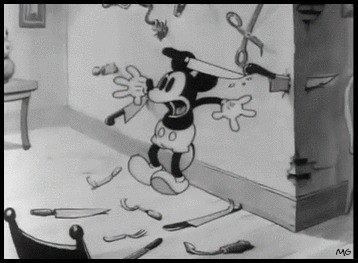
29 Ben 72 4-8 Kids throw knives
29A Ben 150 9-6 Knives landing around Mickey

By way of speculation I’d say a decision was made regarding how the knives were going to play out in the scene. Pure speculation… they needed to make sure the audience wasn’t left guessing about where the knives ended up that Mickey wasn’t really in danger(!) Sure, why not.

I have some other screen grabs of some artwork etc. from the film and if anyone is interested I can be easily convinced to post them. Just put in a request in the comments.

All in all a very fun study and I’ve just begun to scratch the surface of this film.

Many thanks to Hans Perk for the posting the draft. He is performing a great service for everyone interested in animation. His blog again: http://afilmla.blogspot.com

Posted in Disney, Drafts | Tagged , , | 4 Comments

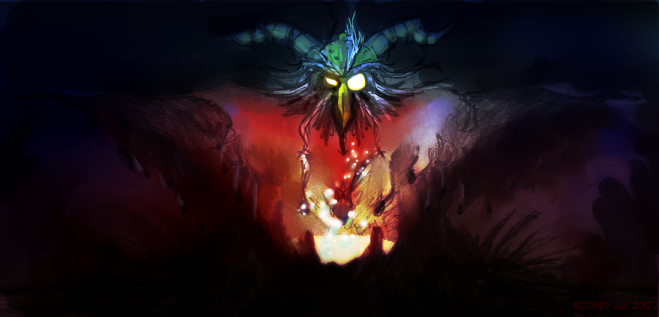
My first post of 2012 is…

The mean ol’ Owl that stole the moon.

Ah, well.
Maybe the heroes will get it back by the end of the year.

Posted in Uncategorized | Leave a comment

Fight for Feedback!

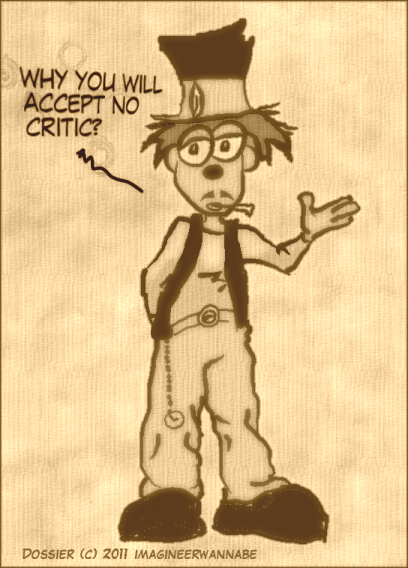
I suppose you could call this something of an inking job over a character sketch by a young artist in the Bluth community by the unlikely name of imagineerwannabe. Parents sure do name their kids strange names these days. But, IMPORTANTLY, the i-man has created a really fun character and he calls him ‘Dossier’… a very cool name!

In the forum he posted his initial sketch and then requested commentary… but added ‘I will accept no critic’. I only mention this because this has become more than just a trend. Critiques (and therefore critics) are exactly the people you want to get feedback from. Those are the one who should be giving both POSITIVE and NEGATIVE feedback. Not negative in the sense that they cannot explain why they dislike something or worse, the they hate something for some personal reason… those aren’t real critics and you can immediately discount them. Seek criticism from people whose opinions (pro or con) you value!

A true friend is someone who (if and when it was proper) say to your face what other people wouldn’t only say behind your back. While not always pleasant, feedback of this form is extremely valuable. When you get criticism don’t take it personally, a good critic will expect you to accept what you agree with and throw the rest out.

At any rate… that’s just my thoughts on the matter.

Great job thus far on this guy. this Dossier looks like a really interesting fellow.

This particular drawing was inked over the original sketch with my finger on a 2inch x 2inch laptop stylus pad. The left arm (screen right) is something I added.

Posted in Uncategorized | Leave a comment