Michael Sporn (1946 to 2014)

The animation community has lost a dear friend.

On 19 January 2014 Michael Sporn lost his three year battle with pancreatic cancer.

I am greatly saddened by this news.

Michael Barrier has a short bio and write up on Michael on his blog:

http://michaelbarrier.com/Home%20Page/WhatsNewArchivesJan14.html#michaelsporn19462014

Posted in Uncategorized | Leave a comment

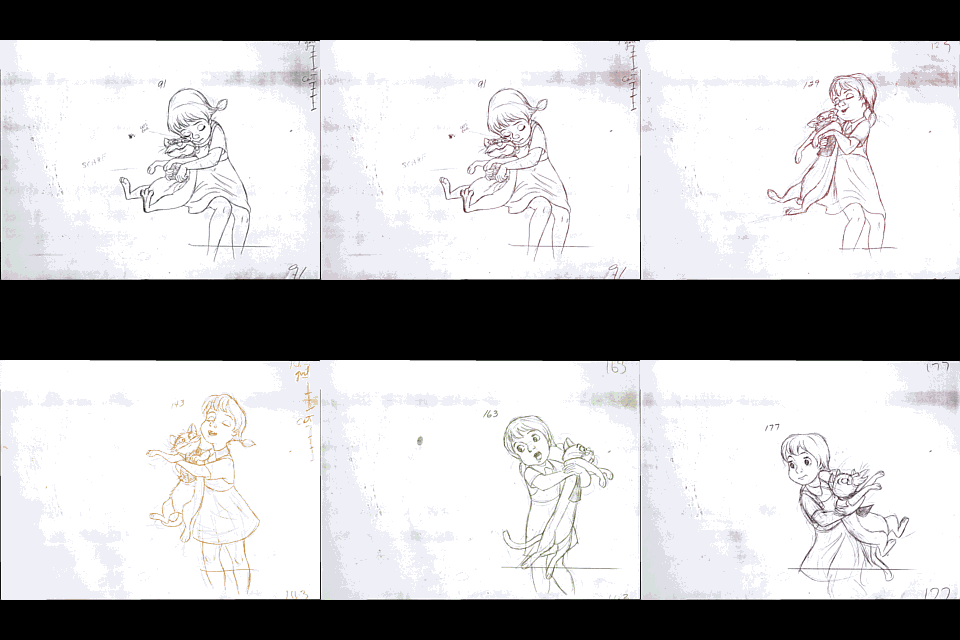
Ollie Johnston animating Penny

Andreas Deja continues to post outstanding works over at his blog.

This short sequence of drawings comes from images he posted and I spent time putting together and investingating.  The drawings are by Ollie Johnston.  The color is not from the originals but rather is my (failed?) attempt to analyze the further breakdowns and inbetweens that might be generated from these keys/extremes.  In attempting to reverse engineer I was attempting to use the program Animation:Master in ways that it really isn’t intended to be used but I’m having fun using it to analyze animation while at the same time  digging deeper into what is there in the program itself.

Breakin Down and In Betweenin

Concerning the drawings themselves, I hope to comment more on them and post some of the fun observations I made while reviewing them.

One example of something worth noting is that of frame 123 which, if taken in isolation, would suggest that Penny is angry, cross or frustrated with Rufus.  This certainly isn’t the case and it’s worth noting that these highly skilled Disney animators had a keen sense of the use of ‘microexpressions’ long before Paul Eckman made the term popular.  Penny’s face seems to support two primary motivations; firstly it serves as an anticipation for Penny picking up Rufus (it helps to suggest he has some weight).  Secondly, and perhaps more importantly, it helps to reveal Penny’s inner turmoil, her frustration with the fact of being passed over for adoption.  Despite Rufus’s reassurance Penny isn’t dealing with her thoughts of rejection very well.

The staging of this sequence is also well conceived.  It requires Penny to go from a sitting position on the window ledge, drop to the floor and then walk across the screen carrying Rufus.  This movement maximizes screen space while having the character transition in three dimensional space.

Ref:  http://andreasdeja.blogspot.com/2013/05/vance-gerry-ollie-johnston.html

Posted in Uncategorized | Leave a comment

Get a plan.

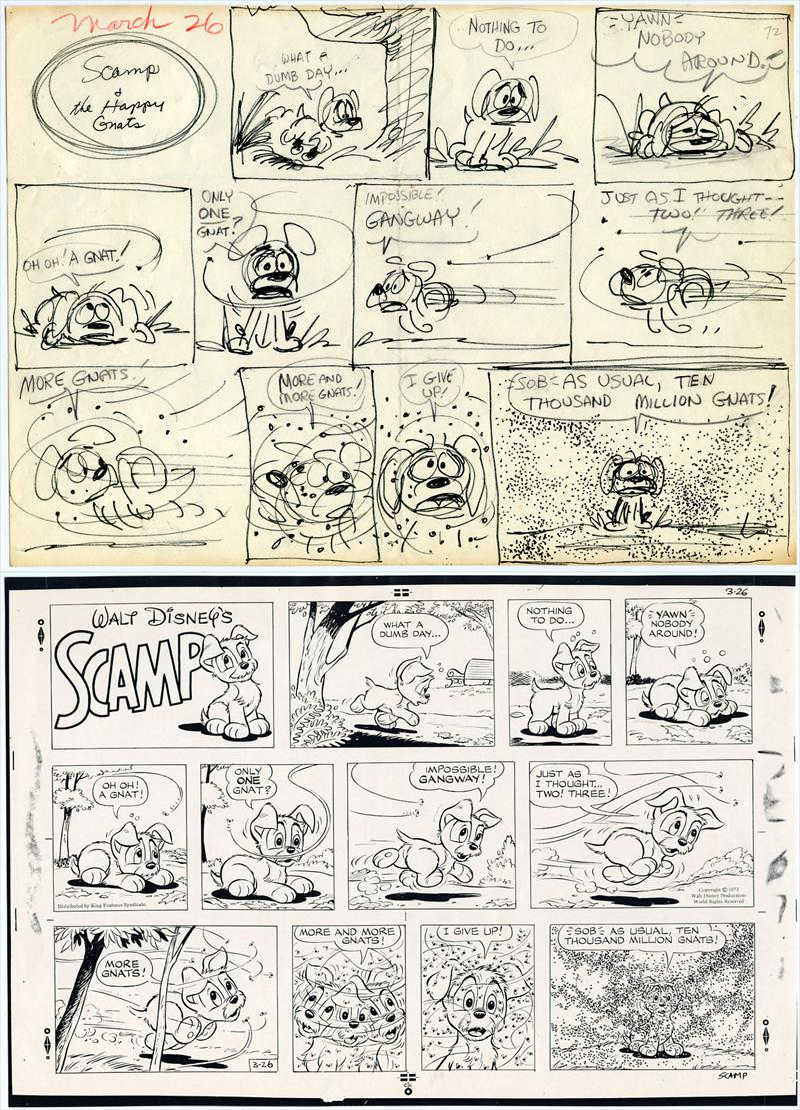
I always enjoy ‘behind the scenes’ looks into production and I especially enjoy finding roughs and preparatory sketches that proceeded the final professional presentation.

What it reminds us of is that these talented folks drew crude drawings, struggled to bring ideas to reality and worked hard to get to that final state of a finished product.


GetaPlan


So, how do you get to that final product?

First develop and then follow a plan.


Posted in Uncategorized | Leave a comment

Drafts from ‘Peter Pan’ posted courtesy of Hans Perk

Hans Perk has been posting the drafts from Peter Pan over at his blog.
If you don’t visit his blog on a regular basis… you are missing out.
Gaining insight into animation production alone will be well worth your effort.

Here are five of the pages from sequence 11, “Hook Tricks Tinker Bell”.

Prod2074 PeterPan Draft Seq 11 pages 129-134  (PDF File)

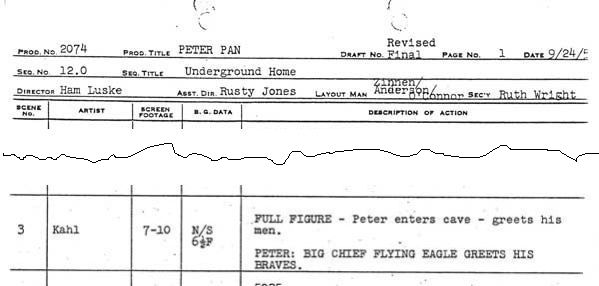
Here, by way of further preview, is an excerpt from a page from the draft of Sequence 12 (not posted here…vist Han’s Blog for that):

Example

and the animation produced:

s3MiltKahl

Obviously the quality has been drastically degraded in this gif animation.  I’m posting this primarily as a preview toward the actual scene in full quality… just a representational taste of it here.  Study it in it’s full glory if you can.

Note also how the Background Data plays out in the movement of the camera North to South to 6 1/2 Field which zooms into Peter and progresses the shot.  The following shot then is cut to a perfect close up of Peter as he delivers his line to the Lost Boys in the voice of the Chief, “HOW”.   (See correction below from Hans.)

Hans has noted these drafts are all dated within a few months of the untimely death of Freddy Moore. That flavors this look back on animation production with strong dose of sober reality. These names weren’t just words on paper, they were real people with dreams and aspirations. When one considers the art of this Disney classic and what the artists and animators achieved in the film it becomes all the more impressive.

Check out Hans’s blog:  http://afilmla.blogspot.com/

Update/Correction:  Hans has added a correction in the comments that I’ll share here:

Just a little note: when it says N/S 6½ in the BG column, it actually means it is a New Still background that uses a 6½F setup (that is the outer field) – in contrast to a 5F as used for the earlier films or close-up, or a 10F which is on the Multiplane camera. One of the first postings on my blog is about this stuff. The Disney fields you can compare to “ACME” sizes on a separate page through a link on my blog, but I will divulge that this one is 14.4″ wide. The ealier drafts actually indicated the actual fields, the later ones just the outer field setup.
Now – there is obviously a truck (zoom) in this scene, so that either may have been planned “after the fact,” or a truck like this with only a slight East-West movement is not really also considered a pan, as otherwise the column would read N/P.

Thanks Hans!

Posted in Uncategorized | 2 Comments

Michel Gagne’s ‘Saga of Rex’

I’ve joined in the support of Michel Gagne’s short film which is to be a four minute hand drawn animated film.  I recommend you do the same.

Saga of Rex Kickstarter

As the project has already reached it’s first goal it’s going to be made but supporting it now will take it to the next level.  For $20 you can even get access to a special ‘Behind the Scenes Prodution Blog’ where Michel posts about the joys and challenges of making the film.

Personally I’d love to see him make a full feature length film.


Posted in Uncategorized | Leave a comment

Milt Kahl Sequence from ‘Robin Hood’

It’s no secret that the Disney film ‘Robin Hood’ is a favorite of mine.

Every time I see it, or artwork from the movie, I’m reminded why.

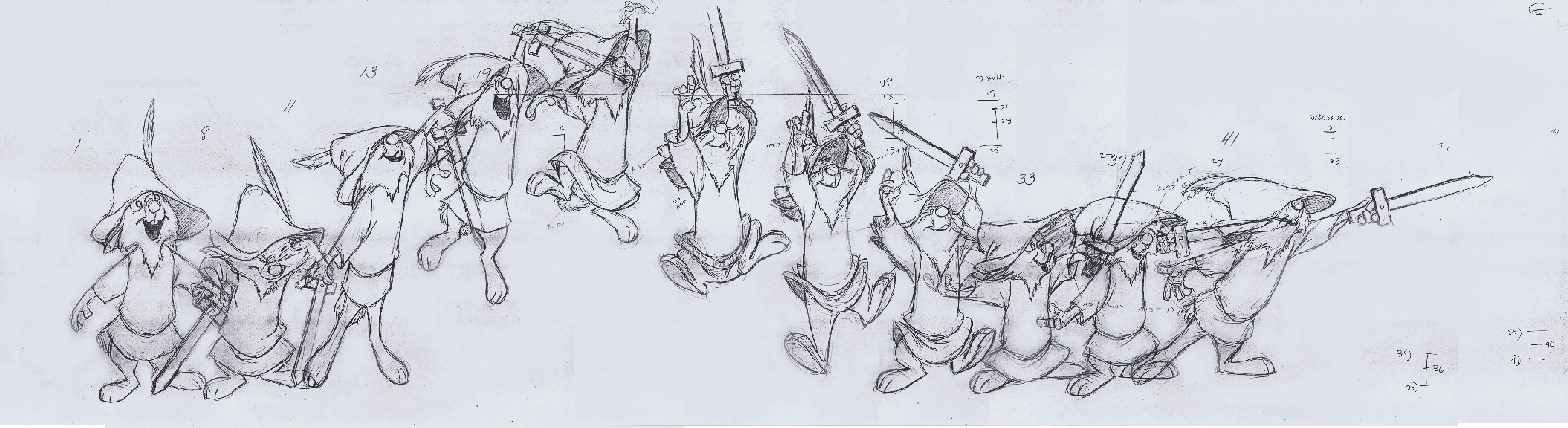
Andreas Deja has recently been posting artwork and animation from the film on his blog and I couldn’t resist creating a montage of one of the sequences he posted.  Note that the combining of individual drawings often gives a false impression of the action that is occurring in the animation but it can also provide some useful insights as well.  In this case the little rabbit ‘Skippy’ is jumping straight up and down but by offsetting the drawings it’s easier to see the differences that are occurring from frame to frame.

Milt is at his best here.

Just pick a point or shape on the first drawing (on the left) and follow it through the entire sequence.  Note the range of motion, direction and area of the frame that it is in.  Then go back and pick another point or shape and do the same thing.  Milt is a master of using the screen to its fullest potential.

There is a lot more to see here of course.  The arcs, the squash and stretch, follow-through and secondary action.  Watch that feather.  Follow the sword.  Note the frame cut off at the top as Skippy jumps up out of the viewable area of the screen and then later thrusts his wooden sword out of screen right.  See the asymmetry that keeps the character’s action from being boring and maintains the eye’s interest in further exploration.

Of course, the smaller images here don’t do this artwork justice and the detail will be hard to examine, so check out Andreas’s blog to see the full scans!  Visit his blog frequently… as often as you can!

http://andreasdeja.blogspot.com/2012/04/skippy.html

Posted in Uncategorized | 2 Comments

Exhibit A: Why Stan was the Man

This seems fitting for my first posting with a focus on comics.  It’s such a treasure trove of material that I have five titles that this could have fallen under.

It’s hard to talk about comics without mentioning a few names and two of them are Stan Lee and Jack Kirby.  We’ll talk more about the King of Comics later (there is a lot to talk about when it comes to Jack Kirby!) and for now demonstrate some of the genius of Stan.

Here we see a short two pages of notes that discusses a cover of an issue of Avengers Giant Size (which is much like an Annual).   Because the image may be a bit hard to read here’s a copy of that text:

From the Desk of … Stan Lee

(To) Len Wein:

Len:

There are 2 “dead spaces” on this cover.  In one of them, I added balloon “AVENGERS ASSEMBLE!”

In the other, I indicated a splash area for a blurb.  Try to write something to the effect of SPECIAL ACTION ISSUE!  COSTUMED SUPER-STARS IN PROFUSION, BATTLING TO THE DEATH!

Always look for, and try to recognize, the so-called “dead areas”.   By livening them up, either with additional artwork, or zippy copy, you can often add a helluva lot more excitement to a cover.  It’s one of the things that always gave and will give us an edge over the competition.

Discuss this with Marv and explain to all your assistant editors too.  It’s really a most important point.

(See additional attached note – Stan)

Another important point which goes for ALL covers, as well as this one—

Note Giant-man’s face, and Hawkeye’s, and Dr. Strange’s…. They don’t look EXCITED enough—or VIOLENT enuff, or SCARED enough, or ANGRY enuff, or whatever.

ALWAYS make sure the characters have some sort of extreme, exciting expression on covers—and of course, inside as well.  We can never convince reader story story is exciting if the characters themselves don’t look excited!

I’ve told this to all our staff a million times over the years, but it can’t be mentioned too often.  It’s VITALLY important.  Often a story that seems dull could seem twice as exciting with more excitement being registered by the characters.  Always look for, and try to remedy, such situations.

-Stan

The first thing to note is that without specifically saying it, Stan has made a distinction between negative space and dead space.  His focus is fully on dead space here.  What is dead space?   Well, first and foremost Stan relates that it is something he has stated ‘millions of times’ and stresses as a “most important point.”  Dead spaces are those areas on the cover and on the inside pages of comic books that Stan directs Len to “Always look for”,  to “try to recognize”, and to “liven up” by adding artwork and text.  Stan suggests that by livening up these dead spaces in such a way they will add “a helluva lot more excitement” which was something that historically given them a competitive edge and would continue to do so if they continued to pay proper attention to it.

But Stan isn’t just filling space for the sake of filling space.  He’s enlivening those spaces where which were dead.

Moving on to his additional notes Stan then further directs Len to consider something of vital importance; that each character’s facial expressions must be drawn as an extreme and not just as a well drawn face.  He then even emphasizes how those faces should look; excited, violent, scared, angry… whatever!  Not a tame boring word in there but every one full of action; the very essence of the superhero.

These extreme emotions are caricatured by exaggerating the emotions projected from the characters.  But why should we target these extremes?  Stan answers that with expert insight by suggesting that readers cannot be convinced to be excited if the  characters are not excited themselves.  So obvious it shouldn’t have to be said right?  Sure, but if that is the case why did Stan need to say it and say it repeatedly?  Because there was no evidence of those emotions being expressed in the characters the artist (however talented) had drawn on the page.

He finishes his note with an admonishment:  “Always look for, and try to remedy, such situations.”

Images/Scans courtesy of:  http://themarvelageofcomics.tumblr.com

Posted in Uncategorized | Leave a comment

More Tap!

The last post was about tapping and this is an extension of the theme.  I want to call your mind to it via two recommendations; one another blog and one a video lecture course.

Last month, Ferdinand Englander posted on animating to beats in a post titled:  ANIMATION SECRET: ANIMATING TO MUSIC.

Check it out, it’s highly recommended.

(Here’s a direct link if the image above doesn’t work:  http://www.animatorisland.com/?p=174)

For folks like me that are a bit short on musical talent I highly recommend the video lecture over at Yale University.  It’s serious enough to work if’n it sinks in.  😉

Here’s a brief description of the course:

Professor Wright begins this lecture with a brief introduction to musical acoustics, discussing the way multiple partials combine to make up every tone. He reviews fundamental rhythmic terms, such as “beat,” “tempo,” and “meter,” and then demonstrates in more depth some of the more complex concepts, such as “syncopation” and the “triplet.” Professor Wright then moves on to discuss the basics of musical texture, giving detailed examples of three primary types: monophonic, homophonic, and polyphonic. The class is then taught the basics of rhythmic dictation — skill that entails notating the rhythm of a piece after listening to it. Each of these disparate threads is brought together in the conclusion of the lecture, in which Mozart’s Requiem is shown to weave different rhythms, textures, and pitches together to depict the text effectively.

The Link:  http://videolectures.net/yalemusi112f08_listening_music/

 All in all 10 lectures of about 1 hour each (10 hours total) of very useful ‘musical listening’ training.  I’m watching them now in hope that something might sink in! 🙂

One useful bit I picked up on was how the emphasis is placed on the down beat.  This is also where musicians often facilitate rhythmic change.

The last post was of a silent animation but hopefully they won’t always be!

Posted in Uncategorized | Leave a comment

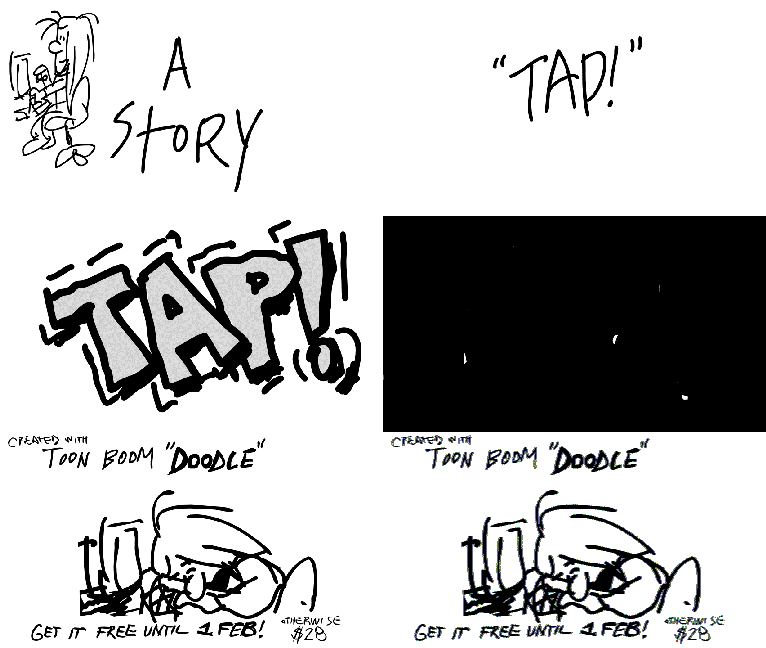
‘Tap!’ a (very) short film created with Toon Boom Doodle

Today is 18 Jan (in Japan)… do your kids have Toom Boom Doodle yet?

Only 13 days to go before you gonna haffa pay .

Today I reinstalled TBDoodle (because for some strange reason it disappeared off my computer!)  Recommendation:  Save a copy of the program installer *and* your activation code!  As you can see below the re-installation worked fine.  It would not have been great to get to 2 February and realize I’d lost my activation code or went to download the program again only to find it was no longer available.

So, anyway… I started doodling and the lines all kind of bunched up together to form this thing…

I also drew a couple of Owls and a kid playin’ superhero as an attempt to create some storyboard-type stuff… and make sure I understood Doodle’s Library.

Kidstuff.  Gotta love it.

So simple that drawing is fun again.

(Note: The program doesn’t create gif animation. If you are curious ask me about that process and I’ll be glad to talk about it here.)

Posted in Uncategorized | Leave a comment

Toon Boom Doodle (Free until 1 February)

I’ve been sitting on this for a few days while thinking how best to suggest it to everyone. Most who are into animation already have something capable of animating similarly.

In conjunction with CES 2012 Toon Boom is releasing their Doodle software.
See this announcement.

So here is the deal… I challenge and encourage everyone to find as many kids as possible and help them download and install Toon Boom’s Doodle. With it they can learn how to animate. I believe many will learn how to animate better, faster with more effectively use timing because of this software. I sure wish I’d had access to TBDoodle and the knowledge of animation available today when I was going up.

Download Toon Boom Doodle for free (until 1 February)

…and this isn’t just for kids. You can use Doodle to quickly sketch out and time your animation.
Get this software onto every kids computer so they too can learn the art of animation.

Personally, I think Toon Boom will offer this again but kids everywhere should have to wait. They need to start animating now!

Posted in Uncategorized | 1 Comment